Showing posts with label Situationist International. Show all posts

Monday, March 12, 2012

Scott Hocking's Garden of the Gods

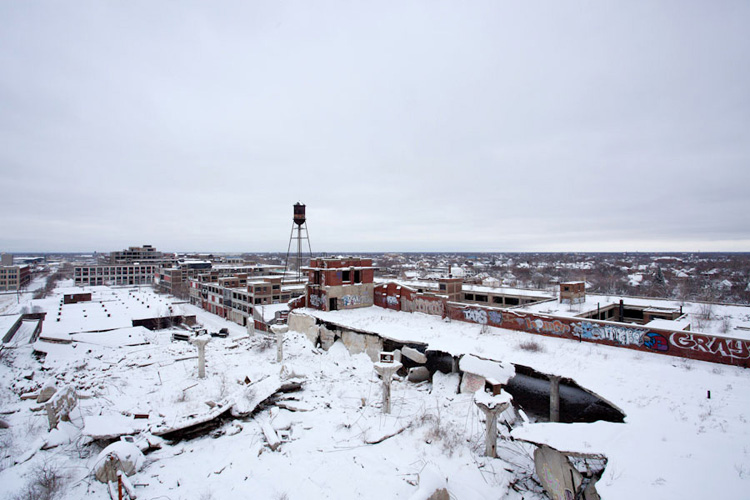
The long-abandoned 3.5 million square foot Packard Automotive Plant, production site of one of America's premier automotive luxury brands, has been recently slated for demolition (photo: Albert Duce, Creative Commons license CC BY-SA 3.0).
It was recently announced that after more than five decades of abandonment and neglect, the sprawling, decrepit Packard Automotive Plant on the east side of Detroit will be demolished by its ostensible current owner Dominic Cristini. (For news coverage, click here, here, here, and here.) Designed in the early 1900s by industrial architect Albert Kahn, the 40-acre, 3.5 million square foot complex was once the headquarters and main production site for the Packard Motor Car Company, one of the premier American luxury automobile brands of the 20th century. The plant was the first large-scale reinforced concrete industrial construction project in the world and at its opening in 1907 was considered to be the most advanced facility of its kind anywhere. The plant's opening preceded by three years Henry Ford's legendary Highland Park Plant (also designed by Kahn and immortalized by Louis-Ferdinand Celine in Journey to the End of the Night -- for $5 a Day) and the moving assembly line by six.

Since its closing in 1958, the complex has progressively fallen into decay with several sections in collapse as a result of exposure to the elements and a succession of fires; although, most of the buildings remain structurally sound due to their reinforced concrete construction. Much of the wiring and other building materials have been stripped by scavengers over the years. In recent times, the plant has also served as an enclave for so-called urban explorers, graffiti artists, and purveyors of the photographic genre known as "ruin porn." Without question, the most significant work done in this environment is that of Detroit artist Scott Hocking.


Born in Detroit in 1975, Hocking has been surveying the postindustrial landscape of Detroit for more than a decade. His project Relics, begun in 2001 in collaboration with Detroit artist Clinton Snider, has collected thousands of found objects and organized them into various grid configurations, which are exhibited from time to time. The result of an ongoing series of Situationist-like derives (drifts) through the city's wastelands, Relics gathers up the castoffs of modernity's material culture and presents them as metonyms of lives and livelihoods ruined in the transition from the Fordist to the post-Fordist mode of production, a tidal wave of creative destruction under which vast sections of Detroit have been literally and figuratively washed away. Permeated with the smell of grime and decay and odors of chemicals whose half-lives will persist into future centuries, the assemblages of broken toys, appliance fragments, rotted clothing, rusted machine parts, architectural remnants, and other abandoned ephemera, register the psychic realignment that has taken place in the migration from the age of mechanical reproduction to the regime of neoliberalism, of all that was once solid melting into air.
Scott Hocking and Clinton Snider, Relics, 2001, mixed mediums (original installation view at the Detroit Institute of Arts). (All Hocking images courtesy of the artist and Susanne Hilberry Gallery.)
Hocking's installation in the Packard Plant, Garden of the Gods (2009-2011), is among his most remarked-upon works, and it is arguably one of the most significant. Situated in a section of an upper floor where the roof has collapsed, the piece uses columns still standing amidst the rubble as pedestals upon which are perched old TV consoles retrieved from elsewhere in the building. (At one point in its devolution, the plant was used in part as storage space. One loft area was apparently used by a television repair and recycling service, the remains of which are still there.) 

Taking its title from a sedimentary rock formation in the Shawnee National Forest in southern Illinois, Garden of the Gods takes each of its 12 monuments as a member of the Greek pantheon. Over time some of these have also fallen over and other pieces of the structure have collapsed. The process of entropy has been photographically documented periodically since the TVs were first installed in 2009.


Top: Scott Hocking, Garden of the Gods, West, Summer.
Middle: Garden of the Gods, West, Winter.
Bottom: Garden of the Gods, Northeast, Snow.
Hocking readily acknowledges the site-specificity of this and other works, yet at the same time he gestures toward a broader historical view. From a mythological perspective, Garden of the Gods is a meditation on the hubris and repeated failure of humankind's stratagems of control over nature, a mytheme that goes back into distant times. (For an excellent interview with the artist on this and other aspects of his work, see Sarah Margolis-Pineo's "Seeing Beauty in All Stages.")

Closer to the present, Garden of the Gods can be read as a dystopian reflection of the effects of spectacle society. Hocking talks of thinking about the site originally as reminiscent of a classical amphitheater, a stage upon which to present a cast of epic characters. Coming then upon the trove of abandoned televisions sets, he instantly made the connection between the upright pillars and  the TV consoles as the appropriate dramatis personae. "It is almost too simplistic that the TVs are new gods," the artist has said. But I would argue that in this regard Garden of the Gods is in fact quite astute.

In his classic study Television: Technology and Cultural Form, Raymond Williams asserts that the rise of TV as the quintessential mass medium of the postwar era is inextricably bound up in its ability to communicate over large distances via the broadcast signal. In the United States, television worked in concert with the personal automobile and the suburban single-family housing development to demassify the urban core and construct a national imaginary based on the concept of "mobile privatization," the idea that one could the survey outside world from the comfort and security of one's own living room. (An excellent study on the effects of this process in American society during the 1960s and beyond is Joshua Meyrowitz's No Sense of Place: The Impact of Electronic Media on Social Behavior.) And while the inner city has been substantially abandoned and thus devastated, the suburbs surrounding Detroit are actually quite the opposite. (Oakland County, just north of the city, is one of the nation's most affluent areas.) Mobile privatization became the means by which the public sphere imploded only to be replaced by the isolation of a domestic simulacrum whose only respite is consumerism, the true god being worshipped through the medium of TV.

The physical and psychic traces of the repercussions of mobile privatization and its consumerist orientation are stunningly apparent in Detroit. In light of the recent, and some say terminal, crises of the modern capitalist world-system, Garden of the Gods is a harbinger of what the future may hold.


Above: Scott Hocking, Zeus Summer.
Below: Zeus Destroyed.

Wednesday, February 1, 2012

Envisioning Real Utopias in Detroit

Artist Mitch Cope of Design 99 brings sustainable light to the Power House neighborhood. (Image courtesy of Mitch Cope and Gina Reichert.)
Over the last year and a half, I have looked at the field of cultural production in Detroit through several lenses. As I've reflected on things a little more, I have to come to see that these lenses are interconnected. What's more, they point to a way in which certain art projects in Detroit are perhaps opening up an avenue for thinking about how we might actually go about making that other world the new social movements slogans tell us is possible.

The first iteration has been to think in terms of something I call the art of the commons. This lens reveals a significant (though certainly not exclusive) tendency within contemporary Detroit art that has emerged in those spaces where the distinctions between public and private seems to have dissipated as part of the process of demassification of the city's core, which has taken place over the last four decades. (As the wisdom of Old Moor has it, "All that is solid melts into air.") The resulting abandonment of commercial and residential property, its subsequent neglect, and its reclamation in many quarters by nature has figuratively and in not a few cases quite literally opened up a new field of cultural production. Referring back to the medieval commons (land left open for grazing, farming, and other uses by anyone without requiring individual ownership -- the term "commoner," i.e., one without hereditary title, comes from it), the art of commons trespasses the boundaries of conventional property relations of the modern capitalism.

The idea that private property is essentially an ideological construction, something legitimated by hegemonic authority, in this case what Immanuel Wallerstein terms "the capitalist world system," and not a natural right that exists in perpetuity, underlies the psychogeographic investigations of the urban landscape undertaken by the Situationist International, which constitutes the second filter. In particular, the SI concepts of derive (drift), detournement (diversion, derailment), the gift economy, and potlatch provide useful ideal types for understanding how cultural producers in Detroit negotiate the city's postindustrial condition. (See the post "Beneath the Pavement, the Beach!" for my analysis of Detroit art from a Situationist perspective.)

The work has resulted from these investigations seems to be best embodied by the third lens, Jacques Ranciere's notion of aesthetic community. As I have noted in my post, "Aesthetic Community in Detroit," this conception of community isn't defined by the network of producers so much as it is by the conscious collective of ideas they are making tangible. There is the sense data of course, that is, the material artifacts, spatial constructions, and interpersonal connections, but more important is the dialectical relationship of the acknowledgment of what is coupled with the vision of what could be. Putting this vision into practice is the lynchpin of what Ranciere identifies as the connection between aesthetics and politics.

How we might look at this confluence of ideas from a sociological perspective can be found in Eric Olin Wright's model of social change, the real utopia. As opposed to conventional utopias, which are ideal communities of admittedly unattainable perfection, real utopias, according to Wright, combine "principles and rationales for different emancipatory visions with the analysis of pragmatic problems of institutional design." Real utopias are ways of envisioning conditions of social and political justice that are at once desirable, viable, and achievable. In keeping with this, real utopias are thus models of emancipatory social transformation, alternative ways of providing for human well being. Of the three possible avenues of emancipatory transformation Wright offers, the aesthetic community of Detroit "intersticial transformation," forms of empowerment that operate in the "niches, spaces, and margins of capitalist society," in other words, what I have been calling the commons.

There is no better example of this in Detroit than work that has been done over the last five or so years by Design 99, the collaboration of artist Mitch Cope and architect Gina Reichert. Started as a design consulting studio and retail space, Design 99 has evolved into broad-based conduit for exploring models of contemporary art and architectural practice and community engagement. In 2008, Design 99 acquired a foreclosed and abandoned residential structure on Detroit's northeast side for $1800, which they began to use as a test site for sustainable design and social practice. Project plans called for the structure to be rehabilitated using recycled materials and be completely energy self-sufficient, combining wind and solar technologies for all of its power needs. The project soon attracted attention and support from local residents. Kids started coming by to help paint and plant, and the daily proceedings became a source of conversation for adults.
Design 99, Power House, 2008-present. (Image courtesy of Mitch Cope and Gina Reichert).
In 2009, Cope and Reichert formed Power House Productions, a nonprofit organization to extend their work into the nearby neighborhood in a more comprehensive and coordinated way. Founded in the wake of the 2008 financial meltdown, the organization started as defensive mechanism against the increase in crime and vandalism that plagued the already blighted neighborhood. The "power" in Power House soon came to be more than a descriptor of its energy sources; it came to mean more significantly empowerment of the local community. Power House Productions facilitated the acquisition of eight more houses and three empty lots in the neighborhood. Five of those properties are currently undergoing rehabilitation for use as primary residences. There are also community gardens, neighborhood clean-ups, and neighborhood watch programs in effect. Future plans call for a neighborhood bike shop (Detroit has become a major bike city), a series of artists residencies and workshops, and a skateboard park. The San Francisco-based magazine Juxtapoz also partnered with Power House Productions recently on a multiple-location art-installation project.

Related projects have now followed. The University of Michigan School of Architecture sponsored five graduate fellowships in 2009-2010 to conduct design research, purchasing a house in the neighborhood to allow them to work at full scale. Chicago-based artists Sarah Wagner and Jon Brumit moved in and formed the project DFLUX Research Studio to explore the possibilities of emergent creative cottage industries, famously purchasing a house for $100 in which to conduct their activities. The artist Graem Whyte (himself co-director of another nearby artists' enterprise Popps Packing) is working on the Squash House project, a site-specific interaction space focusing on play and gardening as the primary mechanisms for community building. Like the Power House, it will be energy self-sufficient and use recycled materials wherever possible.
Artist Graem Whyte posing in Squash House, a project to convert an abandoned home into a gamespace and community garden. (Image courtesy of the artist.)
In his book Envisioning Real Utopias, Wright identifies two interstitial strategies, "revolutionary" and "evolutionary," both of which are connected to the anarchic idea of politics outside the modern state. The former ultimately proposes a rupture with the political economy of capitalism, the latter a more gradual "withering away" as it were. The interstitial strategies of cultural producers in Detroit strike me as being more of the evolutionary variety. (Indeed, local activist and theorist Grace Lee Boggs notes that the new social movements in Detroit are putting the "evolution" in the "revolution.") As Wright notes, evolutionary interstitial strategies often emerge in situations where conventional structures are simply aren't available. It's essentially a form of social bricolage (in contemporary parlance DIY), which has the potential to become a new order. As Wright further notes, the bourgeois class, and thus modern capitalism, emerged in what Wallerstein terms "the long 16th century" from the interstices of the medieval system. While it may be admittedly utopian to think so at this point, we could be in the process of witnessing a similar transformation today.

Monday, August 1, 2011

Beneath the Pavement, the Beach! -- Detroit from a Situationist Perspective

The current events blog Deliberately Considered recently published my review of the new book by McKenzie Wark, The Beach Beneath the Street: The Everyday Life and Glorious Times of the Situationist International (Verso, 2011). The book takes its title from the famous grafitto of the general strike of May 1968 in France: "Sous les paves, la plage!" (Under the pavement, the beach!) It updates the Situationist legacy for the present day, and it seeks to offer a more nuanced view of the movement and its key players. In particular, it looks beyond Guy Debord, his writing, and his films to consider the activities of those whose contributions to SI have often gone under-recognized. Among the cast of characters: Unitary Urbanist Constant, CoBrA co-founder Asger Jorn, French novelist Michelle Bernstein, and Dutch painter Jacqueline De Jong.

In reading Wark's book, I couldn't help but think about the practice of art in the city of Detroit. In the second chapter, titled "No More Temples in the Sun," Wark writes about the Letterist Ivan Chtcheglov, a Parisian poet and anarchist of Ukrainian descent who once conspired to blow up the Eiffel Tower. Chtcheglov is known today mainly for his treatise "Formulary for a New Urbanism" (1953) in which he mentions the concept of derive (drift) that will become a key idea in the Situationist approach to negotiating urban space. Rejecting the top-down rationalism that modernist architect Le Corbusier in particular sought to impose on the urban domain, Chtcheglov writes in the "Formulary": "All cities are geological. You can’t take three steps without encountering ghosts bearing all the prestige of their legends." Ghostly encounters, real and imagined, form part of the basis of what the Letterists, and subsequently the Situationists who literally and figuratively followed in their footsteps, would term psychogeography, the objective and subjective mapping of experiential space.

Getting back to the geological, i.e., the beach beneath the streets, requires deconstructing the process by which nature has come to be overwritten by culture and of which cities are a concrete manifestation. As Wark notes, this in part entails the recognition that:
The conceit of private property is that it is something fixed, eternal. Once it comes into existence it remains, passed in an unbroken chain of ownership from one title-holder to the next. Yet in the course of time whole cities really do disappear. We live among the ruins. We later cities know that cities are mortal. (29, emphasis added)
In the case of Detroit "the course of time" has progressed rather quickly, basically with the onset of post-Fordism in the early 1970s, though some commentaries rightly see the seeds as having been planted in the suburbanization of the region that began soon after the Second World War. This reversal of the conceit of private property provides basis for what I have called the art of the commons, art that is neither public nor private but that exists in a space in between. And many of the practices that comprise this work have something in common with what Wark tells us about the Situationists.

The first is psychogeography. In the "Introduction to a Critique of Urban Geography," Debord writes that it concerns the study of "specific effects of the geographical environment, whether consciously organized or not, on the emotions and behaviors of individuals." One of the more well-recognized mappings of the ghost world of Detroit is the one undertaken by Tyree Guyton on the city's East Side in the form of the Heidelberg Project. Guyton objectively and subjectively marks out the territory of his experience over the years of the neighborhood where he grew up. The objective might be best represented in the form of the polka dot, which Guyton uses to delineate physical space and to unite the public sphere of the street with the private domain of homes long since abandoned. An example of the subjective is Soles of the Most High, a tree clad with scrap wood on its trunk and festooned with shoes hanging from its crown.
Polka dot dancer on Heidelberg Street. (Photo: Geronimo Patton, courtesy of the Heidelberg Project.)
Tyree Guyton, The Heidelberg Project, 1986-present, showing polka dots on the street and buildings with Soles of the Most High in the center  (Photo: Michelle Figurski, courtesy of the Heidelberg Project.)
"Shoe trees" have a number of interpretations, from simply banal evidence of practical jokers tossing footwear out of their owners' reach to more sinister explanations of gangland territory marking rituals to folklore legends of serial killers using them as trophy displays of their victims. In Guyton's case the tree takes its inspiration from the artist's grandfather, Sam Mackey, a descendent of slaves who helped start the Heidelberg Project in 1986 and who had told Guyton of lynching trees from his youth in the rural South where all that passersby could see were the soles of the victims' shoes dangling overhead. (For more on the visual representation of lynching in Guyton and other contemporary art, see chapter 6 of Dora Apel's Imagery of Lynching: Black Men, White Women, and the Mob, Rutgers, 2004, which has a detail of Soles of the Most High on its cover.) Embedded within this apparition is the psychogeographical trace of the Exodus that took African Americans from sharecropping peonage in the Jim Crow South to "free" wage-labor in the factories of the Promised Land in the North, a redemption that turned out to be only too short-lived as the sense of terroir established in neighborhoods such as Heidelberg disintegrated under post-Fordist deindustrialization and urban disinvestment.

A second Situationist concept is derive, typically rendered in English as "drift," the practice of meandering, unpredictable explorations of an environment in which its psychogeographic characteristics are exposed. The artist Scott Hocking has been exploring the nether regions of the erstwhile Motor City for more than a decade. In addition to sculptural installations that respond to the physical environment, the artist has recorded his perambulations in a series of documentary photographs organized under topics such as "bad" grafitti, abandoned boats and other vehicles, and present-day locations that were once sites of ancient burial mounds. As Debord notes in "Theory of Derive," isn't an entirely aimless pursuit, but one driven by an awareness of psychogeographical effects. One of Hocking's more noteworthy derives is Detroit Love (2007-present).

The project is a miscellany of picturesque images of scenes around the city, moments in place and time that reveal the artist's emotional connection with the environs. The images are often tinged with irony, capturing residues of the collective memory slipping away. Others show the persistence of the life force amidst the ruins. Among the former are Grand Army of the Republic, a head-on view of a Romanesque structure, built in 1899 originally for the Civil War veterans of the Union Army. Shortly before the last vet died in the early 1940s, the City of Detroit took over management of the building, using it as a social services and community center until closing it permanently in 1982. Another is Blue Bird Inn, which in the 1950s and '60s was a mainstay of Detroit's vibrant jazz scene, featuring local artists like Tommy Flanagan, Kenny Burrell, and the Jones Brothers, Elvin, Thad, and Hank, all of whom would go on to become major figures of the post-bebop era in New York City. Among the latter are images of the city's wildlife now free to roam the depopulated zones being reclaimed by nature, the process whereby the beach beneath street has been revealed. Each image reflects on the environment in an archeological way not from the perspective of nostalgia. Each represents different aspects of the here and now, for better or worse.

Scott Hocking, Detroit Love, 2007-present: Above: Grand Army of the Republic. Below: Blue Bird Inn. Bottom: Pheasant (All photos: courtesy of the artist and Susanne Hilberry Gallery.)


Get In My Car & Drive: Nowhere in Detroit (Episode 1) from Kristen Gallerneaux on Vimeo.

Above: Kristen Gallerneaux's recording of Scott Hocking's practice of derive.


A third concept is detournement, diversion or derailment, which is the practice of reusing existing cultural expressions in a way that gives them new meaning and effect. On a formalist aesthetic level, this can be seen as basically the practice of collage, which since the time of the Cubists has allowed pieces of the broken world to be incorporated into works of art. But from the Situationist point of view, it specifically refers to interventions into the materials, processes, and codes of the culture industry (or as the Situationists would have it, spectacle society) the ephemera of a throwaway civilization. As Debord and Letterist Gil J Wolman write in "A User's Guide to Detournement" (1956), "The cheapness of [the spectacle's] products is the heavy artillery that breaks through all the Chinese walls of understanding," a statement itself detourned from the description by Karl Marx and Friedrich Engels in The Communist Manifesto of the role of low-cost commodities in propagating the hegemony of capitalism around the globe.

George Rahme makes work using the remix aesthetic that Situationist detournement anticipated. In the present day, remix has penetrated popular culture primarily through the sampling, looping, and other sonic manipulations of club music, a creative form in which the artist is also proficient, having performed as a musician and DJ in the US and Europe. In his visual production, Rahme similarly assembles found and common materials into scenic mixed-media extravaganzas that look like the hallucinatory reveries of a schizoid Thomas Kincaid (or perhaps it's just an overdose of X).

Many of Rahme's works use cheap art reproductions retrieved from thrift shops and other secondhand sources as their foundation. These kitsch substrates are embellished with collaged elements and hand painting. The resulting pastorals can be read as allegories of postindustrial Detroit, a city that as Ground Zero of Fordist modernity was first made and then unmade by the commodity system.

George Rahme, The Pink of Condition, 2009, mixed media on wood, 48" x 84". (Image courtesy of the artist.)
George Rahme, 8,557, 2009, mixed media on paper, 13" x 10 1/2". (Image courtesy of the artist).
A popular genre much in the news these days is ruin porn, mostly photographic representations of Detroit's decrepit physical plant that meditate on the half-vacant city as a memento mori of capitalist over-accumulation. The ruin figures prominently in the art of the Romantic period dating back to the late 18th century. And the sublime awe of nature in the process of reclaiming the provinces of culture is a significant impulse within it as well as in the fetishizing of decay in ruin porn with which it is inextricably connected. Rahme seems to take aim directly at these postmodern Romantics with his lowbrow amalgamations of bad taste, using the detritus of consumer culture, and in particular so-called high art that has been run through the grinder of the spectacle's image processor and rendered banal, to expose its collective id.

The small collage 8,557 (2009) is a direct take off on Caspar David Friedrich's Wanderer Above the Sea Fog (1818), one of the most famous images of German Romanticism. Rahme's version is constructed on top of a poster of the Alps that features the names of various mountain peaks and their elevations. The title happens to be the elevation of the Scheien Pass near Davos in Switzerland. Besides being a popular ski resort, it's also the site of the annual meetings of the World Economic Forum, one of the prime mechanisms through which what London School of Economics sociologist Leslie Sklair terms the transnational capitalist class quite literally rules the world. Numeric indices are the blunt measuring stick by which capitalism rationalizes all things. And it was Fordism's failure to "make the numbers" that inevitably led to Detroit's decline in the face of globalization.

A fourth concept is that of the gift. Working off the research on gift economies of early social scientists such as Franz Boas and Marcel Mauss, and as subsequently interpreted by the renegade Surrealist Georges Bataille, the Situationists envisioned "a new type of human relationship." This would entail neither the cold calculations of bourgeois exchange nor the asymmetrical obligations of aristocratic bequest, but would instead be based on the egalitarian reciprocity of gifts freely given and received. (See chapter 8, "Exchange and Gift," in The Revolution of Everyday Life by Raoul Vaneigem for an outline of the Situationist conception of the gift.)

The gift is central to the practice of art in the face of the money economy argues Lewis Hyde in his now famous book of the same name. The gift economy informs many aspects of relational aesthetics, for example in the work of Rikrit Taravanija, who creates installations that are the setting for sharing meals and other types of social interaction. Detroit Soup similarly features monthly sharing of meals as a collaborative situation for building an aesthetic community. Dinners are prepared by volunteers who share their current projects and thoughts with attendees who contribute $5 toward the evening. Others then present ideas which are voted upon and the selected proposals are given the entire proceeds to fund execution. Additional events along the model of Detroit Soup are now proliferating around the city.
Voting booths at Detroit Soup. (Photo: Louis Aguilar via iPhone.)
Above: Vanessa Miller and Amy Kaherl discussing Detroit Soup at University of Michigan.

The final concept proceeds directly from the gift and that is the notion of potlatch. A gift-giving festival and economic system practiced among indigenous peoples of the Pacific Northwest prior to the arrival of European colonizers, potlatch was taken initially by the Letterists, who named one of their official journals after it, and subsequently by the Situationists as a way out of what they perceived to be the increasingly reified relationships of capitalist commodity culture. The concept of potlatch figures prominently in Bataille's book The Accursed Share, first published in France in 1949, where it constitutes a rejection of classical Western economic theories based on notions of rational choice. For Bataille, the excess accumulation of any system is destined to be released in luxurious waste, of which the arts were a form however admittedly noble. And for the Situationists, "release" meant first and foremost escape from the tick, tick, ticking of time ruled by the punchclock of capitalist production, which is divided between labor and leisure (the inverse and obverse of alienation within the commodity-spectacle system), starting with the dissolution of art as a separate activity into the practice of everyday life. (See, for example, "Theses on Cultural Revolution" by Debord published in Internationale Situationiste #1, June, 1958.)

In contemporary art, a degraded variety of potlatch takes the form of what Peter Schjeldahl terms "festivalism," art that exists only in exhibitions and thus ostensibly resists commoditization. (Happily, however, "documentation" is there to step up to the plate and pay the bills.) Another well-known festival of luxurious waste is Burning Man, a week-long event that began in the mid-1980s in San Francisco and now takes place each year in the Black Rock Desert of Nevada, culminating in the immolation of a large wooden effigy built for that purpose. In Detroit, a more Goth (and in my opinion more interesting) festival is Theatre Bizarre, a delirious extravaganza that takes place on a Saturday near Halloween in a decaying residential neighborhood near the old Michigan State Fairgrounds in the northern part of the city.

Begun by artists John Dunivant and Ken Poirier a decade ago, Theatre Bizarre is part carney side show, part burlesque theater, and part performance art. Dozens of volunteers come from all over the country in the weeks before to construct the midway, stages, and other attractions. The evening's revelry features some several hundred performers and other workers with attendance of approximately 2500-3000. In 2010, the City of Detroit shut down the project citing numerous code violations. In a New York Times article on the event, Dunivant stated, "We couldn't have gotten away with this anywhere else in the world but Detroit."

Above: Theatre Bizarre highlights.

How long an environment amenable to an art of the commons will last remains to be seen. Forces of what the Situationists termed "recuperation" are already at work. I, for one, hope that it turns out to be more than the passage of few people through a rather brief moment in time.